
The Journey to Becoming Your Best Self
“All the powers in the universe are already ours. It is we who have put our hands before our eyes and cry that it is dark.”
— Swami Vivekananda
The Ache That Starts Everything

It rarely begins with a grand resolution.
It begins on an ordinary evening, when the day is done and the house has gone quiet, and something inside you stirs without permission. Nothing has gone wrong. There is food on the table, work in the morning, people who love you. And still, some small voice asks the question you have been outrunning all year: Is this all I intend to be?
Most of us hurry past that question. We call it ingratitude, or tiredness, or a mood. But it is none of those things. That restlessness is not a flaw in your life; it is a signal from the part of you that has already glimpsed a better version of you and refuses to let you forget it.
The journey to becoming your best self does not begin with a plan. It begins with the courage to sit still and listen to that ache instead of silencing it.
There is a stranger sleeping in your bones,
who wears your face but walks a braver road —
and every quiet evening, it calls you home.
The Mirror Comes Before the Map

Before you can build a better self, you must be willing to see the present one clearly — without flattery, and without cruelty.
This is the hardest step, and the one most people skip. We would much rather begin with the map: the course, the diet, the five-year plan, the new diary bought in January. But a map is useless if you have lied about where you are standing.
Honest self-examination is not self-attack. It sounds like: I am generous with strangers and impatient with my own family. I am talented but undisciplined. I say I have no time, yet I know exactly where my evenings go. Naming a thing plainly takes away its power to keep running your life from the shadows.
Consider Dr. A.P.J. Abdul Kalam. As a boy in Rameswaram, he sold newspapers to help his family. As a young man, his single burning dream was to fly — he sat for the Indian Air Force selection and finished ninth when only eight candidates could be chosen. One rank. An entire dream, gone by a margin so thin it must have felt like mockery.
What he did next is the whole lesson. He did not pretend the loss had not happened, and he did not conclude that he was worthless. He looked honestly at what remained — a scientific mind, an appetite for work, a country that needed builders — and he redirected the same fire toward a different sky. He never flew a fighter aircraft. He helped India launch satellites, and eventually walked into Rashtrapati Bhavan as its President.
The dream you lose is not always the dream you were meant to keep. Sometimes it is only the first, smallest guess your heart made about what it was capable of.
The Unglamorous Middle

Here is the part nobody posts about.
Growth is not a montage. It is a Tuesday. It is the third week, when the excitement has evaporated and the results have not yet arrived, and the only thing holding the whole project together is your willingness to show up unimpressed and do the thing anyway.
Motivation is a wonderful visitor and a terrible employee. It arrives loudly, works for four days, and leaves without notice. What actually builds a person is something far less romantic: a small, repeatable act, performed on the days you do not feel like it. Twenty minutes of reading. One honest conversation a week. The walk you take before the excuses wake up.
Milkha Singh understood this in his body. Orphaned by the violence of Partition, he arrived at athletics through the Indian Army and trained with a severity that alarmed the people around him — running until his body rebelled, then returning the next morning to run again. At the 1960 Rome Olympics he finished fourth, missing an Olympic medal by a sliver of a second. He carried that regret for the rest of his life. But the man India remembers as the Flying Sikh was not made in Rome. He was made in a thousand unwatched mornings on a dusty track, where no one was clapping.
You are not built by your best day. You are built by your average one.
The Fire That Does Not Consume

At some point — and this is a promise, not a warning — the journey will break something you were counting on.
A business will fail. A relationship will end. The body will refuse to cooperate. And you will face the only question that has ever really mattered: does this end me, or does this shape me?
In 1982, an accident on a film set left Amitabh Bachchan close to death, with an entire country praying outside a Mumbai hospital. He recovered. Years later, in his fifties, he moved through a long and difficult professional stretch — the kind of quiet season that arrives for almost everyone eventually, usually at the age when the world expects you to be winding down rather than starting over. He chose to begin again. He stepped onto television, took on roles unlike anything he had played in his youth, and rebuilt his craft in full public view. What followed was not so much a comeback as a reinvention — one that made him more beloved at seventy than he had been at thirty.
Or consider Arunima Sinha, a young national-level volleyball player thrown from a moving train in 2011 while resisting a group of robbers. She lost a leg. Two years later, she stood on the summit of Mount Everest — the first female amputee in the world to do so. She did not climb despite what happened to her. She climbed with all of it strapped to her back, and it turned out she was strong enough to carry it.
Setbacks are not detours from the journey to your best self. Very often, they are the journey. Steel does not become steel in comfort.
Do not curse the fire that finds your name —
the gold lies sleeping in the ore until it burns,
and every furnace has a door on the far side.
Be Gentle With the Person You Are Becoming

There is a version of self-improvement that is really just self-punishment in expensive clothing. It speaks in the language of discipline but runs on contempt. It calls you lazy, undeserving, behind. And it never, ever says well done — because the moment it did, it would be out of a job.
That version does not work. It cannot work. No one has ever hated themselves into becoming someone worth being.
Nelson Mandela spent twenty-seven years in prison. He emerged in 1990 with every conceivable right to bitterness — and chose, instead, to build a nation that included the people who had jailed him. His greatest act of strength was not endurance. It was the refusal to let what was done to him decide who he would be.
If a man could set down that much, you can set down the mistake you made years ago.
Speak to yourself the way you would speak to a child you love and expect much from: warmly, honestly, and with the unshakeable assumption that they are capable of more tomorrow. Standards and tenderness are not opposites. The best teachers in your life proved that to you long ago.
There Is No Arrival — Only Becoming
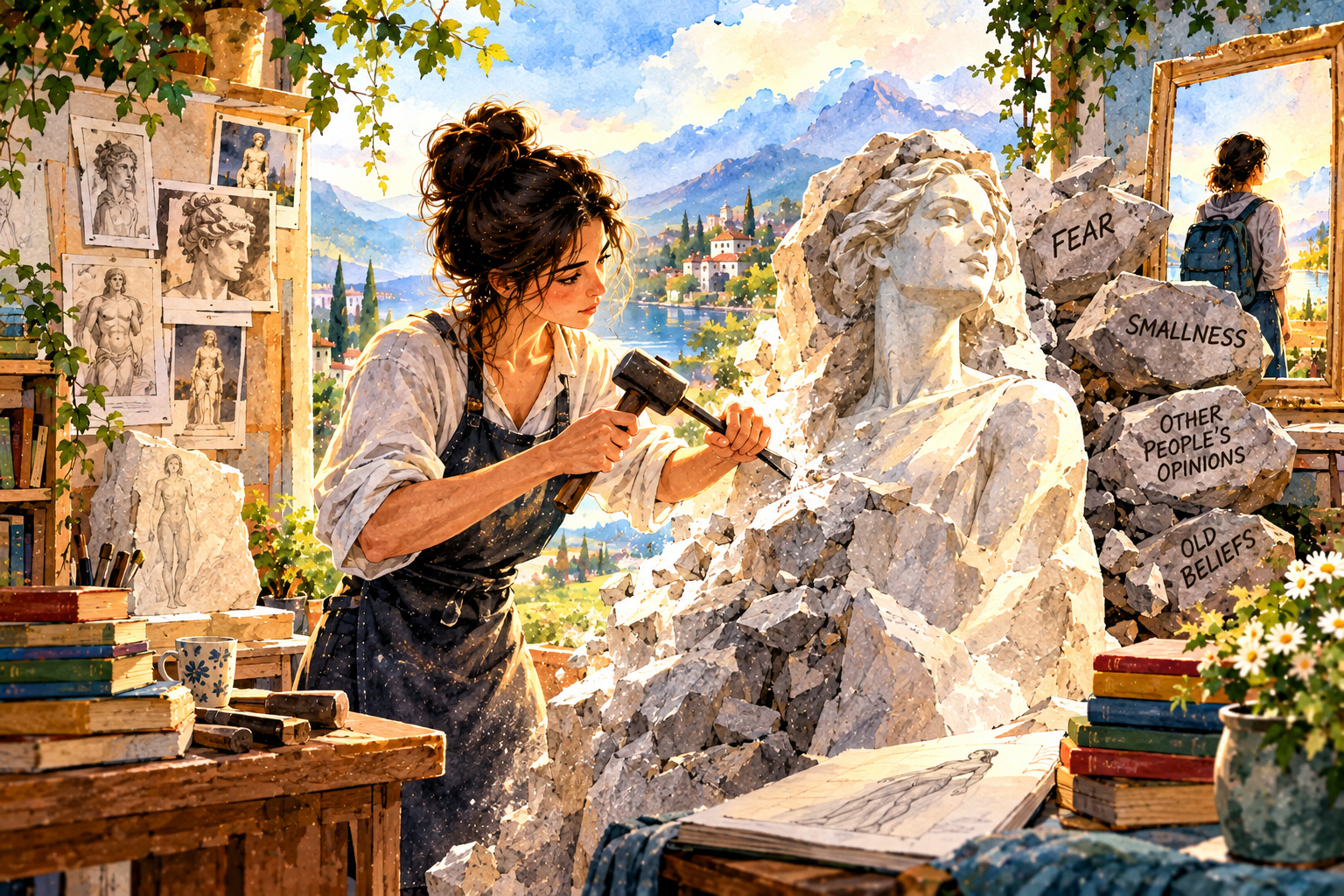
They say that when Michelangelo was asked how he made his sculptures, he said he simply saw the figure trapped in the marble and carved away everything that was not it.
That is the truest picture of this journey. You are not assembling a stranger. You are removing what does not belong: the fear that was handed to you, the smallness you agreed to, the opinions of people who never had to live your life. Underneath all of it, the shape was always there.
And here is the quiet, beautiful catch — you will never finish. There is no morning when you wake up completed. Your best self is not a destination you reach and inhabit forever; it is a direction you keep choosing, on Monday and on Thursday, at twenty-five and at sixty-five.
That is not a disappointment. That is the good news. It means the door has not closed. It means today counts. It means whatever was lost, wasted, or ruined behind you, the marble is still in your hands.
You are not late. The stone is still warm,
the chisel still fits your palm —
begin again, and let the angel out.
Start where you are. Start smaller than you think is worthy. Just start today.
Which single, small, unglamorous act will you commit to this week? Write it down somewhere you will see it — and tell me through a mail. The version of you that has been waiting deserves to be met.