{What truly mends a broken bond between parents and children, partners, siblings and friends.}
❦
It was nearly ten o'clock, and the maths homework still wasn't finished.
Rhea, who is eight, had got the same sum wrong three times. Her father, exhausted after a long day at work, felt his patience snap. "How many times do I have to explain this?" he shouted, and slammed the notebook shut. Rhea's eyes filled with tears. She went to bed without a word.
The next morning, over breakfast, he said it quickly, a little awkwardly, while looking at his phone: "Sorry about last night, okay?"
"It's okay, Papa," she said.
And that was that. The apology had been made. The apology had been accepted. Everyone moved on.
Except that Rhea never asked her father for help with maths again.
Something had broken that evening, and a two-word apology at breakfast had not mended it. Not because the father didn't mean it. He did. But because "sorry" is not the repair. It is only where the repair begins.
❦
The Myth We All Believe
Most of us grew up believing a simple rule: when you hurt someone, you say sorry, and then it's over.
"Say sorry to your sister." "Sorry, okay? Can we move on now?" We learn it so young that it feels like the natural shape of things. A mistake happens, the magic word is spoken, and the slate is wiped clean.
But anyone who has ever received a hollow apology knows the truth. Words alone do not heal a hurt. Sometimes, a quick "sorry" can even deepen the wound, because it seems to say: I'd like this uncomfortable moment to be over, please.
This is the repair myth: the belief that apologising and repairing are the same thing.
They are not. An apology is a door. Repair is the room you enter when you walk through it together.
❦
First, the Good News: Ruptures Are Normal
Before we talk about how to repair, there is something every parent, partner and friend needs to hear: breaks in connection are not a sign that a relationship is failing. They are a normal part of every loving relationship.
Psychologists call these moments ruptures: times when we misunderstand each other, lose our temper, feel hurt, or drift out of tune. And they happen far more often than we imagine.
The developmental psychologist Edward Tronick, famous for his "Still Face" experiments with mothers and babies, spent years filming ordinary, loving parents playing with their infants. He expected to see beautiful harmony. Instead, he found that mothers and babies were truly in sync only about 30% of the time. The rest of the time they were slightly mismatched: a baby looked away while the mother smiled, or the mother glanced away just as the baby reached out.
And yet these babies were thriving. Why? Because what mattered was not the mismatch, but the coming back together. Tronick found that these small moments of repair were constant, and that babies themselves started almost half of them. It is in these tiny cycles of breaking and mending that children learn one of life's most important lessons: when things go wrong between us, we can make them right again.
The same truth holds for adults. The relationship researcher John Gottman studied thousands of couples over several decades. He discovered that happy, lasting couples are not the ones who never fight. They argue, snap and misunderstand each other like everyone else. The difference is that they repair. They soften, reach out, apologise and find their way back to each other, again and again.
So if you have ever shouted at your child, said something unkind to your partner, or hurt a friend, you have not ruined anything. You have simply arrived at the most important moment in any relationship: the moment of repair.
❦
Why "Sorry" Alone So Often Falls Short
Not all apologies are equal. Some heal. Some leave the wound untouched. And some, without our meaning it, make things worse.
Here are a few familiar apologies that sound like repair but aren't:
"I'm sorry, but…" Everything before the "but" disappears. "I'm sorry I shouted, but you never listen" is not an apology. It is a second accusation.
"I'm sorry you feel that way." This apologises for the other person's feelings, not for our own actions. It quietly suggests that the problem is their reaction, not what we did.
"Sorry, okay? Happy now?" An apology used as an exit, delivered to end the discomfort, not to understand the hurt.
The repeated "sorry" that never changes anything. When the same apology follows the same hurt, week after week, the word begins to lose all meaning. Trust erodes, not because the person doesn't feel sorry, but because nothing is ever different.
So what does make an apology work? In 2016, researchers at Ohio State University led by Roy Lewicki tested how 755 people responded to apologies containing different ingredients. They identified six elements: expressing regret, explaining what went wrong, acknowledging responsibility, declaring repentance, offering to repair, and asking for forgiveness.
The findings were striking. The most important element was acknowledging responsibility, simply saying clearly, "It was my fault. I made a mistake." The second most important was offering to repair: committing to put right what went wrong. And the least effective element? Asking for forgiveness.
In other words, a good apology is not about the words "I'm sorry." It is about taking ownership, and then taking action.
❦
What Children Can Teach Us About Sorry
Some of the most revealing research on apologies comes from children, who are refreshingly honest about what makes them feel better.
In a study at the University of Virginia, psychologists Marissa Drell and Vikram Jaswal invited six- and seven-year-olds to build a tower. Then another child knocked it over. Afterwards, the "knocker" did one of four things: apologised on their own, apologised after being told to by an adult, offered to help rebuild the tower, or did nothing at all.
The result is one every parent should know. The only response that actually made the children feel better was the offer to rebuild the tower. Apologies, whether spontaneous or prompted, did not lift their hurt feelings. Yet the apologies still mattered for the friendship: children shared more with a child who had apologised or helped than with one who did nothing at all.
The researchers concluded that making amends does two jobs. Putting things right heals hurt feelings, and apologies mainly help repair the relationship.
Other research shows that by around the age of six, children respond better to apologies that are given freely than to ones that are forced. And children aged seven to nine tend to see a child who apologises only because they were made to as less kind than one who apologised willingly. Children, it turns out, can tell the difference between a sorry that is felt and a sorry that is performed.
This gently challenges one of our most common parenting habits. When we insist, "Say sorry to your brother, right now!", we may teach children the correct words. But unless we also help them understand the hurt and put it right, we may be teaching them that "sorry" is simply the price of ending trouble.
❦
The Anatomy of a True Repair
So what does real repair look like? Whether you are repairing with your child, your partner, or a friend, the same five steps apply.
1. Calm down first. A repair offered in the heat of anger rarely lands. When we are flooded with emotion, our bodies are in fight-or-flight mode, and neither person can truly hear the other. Gottman's research suggests that the body needs a real pause, at least twenty minutes, to calm down after it becomes flooded during an argument. Take a breath, take a walk, drink a glass of water. Then return.
2. Come back, and go first. Repair begins with someone reaching out. In relationships between adults, either person can take this step. But between a parent and a child, repair is always the adult's responsibility. A child should never have to earn back a parent's love after the parent has lost their temper. Come back to them.
3. Name what happened, and own it. Be specific and honest, without excuses. Not "Sorry about last night," but "I shouted at you last night and slammed your notebook shut. That was wrong." You can explain, but never in a way that shifts the blame: "I was very tired, but that is not your fault. It was my job to stay calm."
4. Acknowledge how it felt for them. This is the step we most often skip. "That must have felt scary and upsetting. You were trying your best, and I made you feel like you'd done something terrible." Then pause. Listen. Let them tell you how it felt, without defending yourself. Being truly heard is itself healing.
5. Make it right, and make it different. This is where the tower gets rebuilt. What can you do to put things right now? And what will you do differently next time? "Next time I feel frustrated, I'm going to take a break before I say anything. And tomorrow, let's sit down and do maths together, slowly, with no hurry at all." Then comes the most important part of all: actually do it.
A gentle word of caution. When we apologise to our children, it is important not to drown them in our guilt. If a parent weeps and says, "I'm a terrible mother, I'm so sorry," the child may feel they must comfort the parent. That turns the repair upside down. Keep your apology calm, clear and focused on your child's experience. You are the steady one. That is what makes the repair feel safe.
Why repair matters so much for children. Children often believe that when something goes wrong, it must be their fault. Without repair, a child who has been shouted at may quietly conclude, "I am bad" or "I am stupid at maths." A true repair rewrites that story. It tells the child: You were not the problem. I made a mistake, and I am taking responsibility for it. That message protects a child's sense of self-worth in a way that no quick sorry ever could.
❦
Teaching Children to Repair, Not Just Apologise
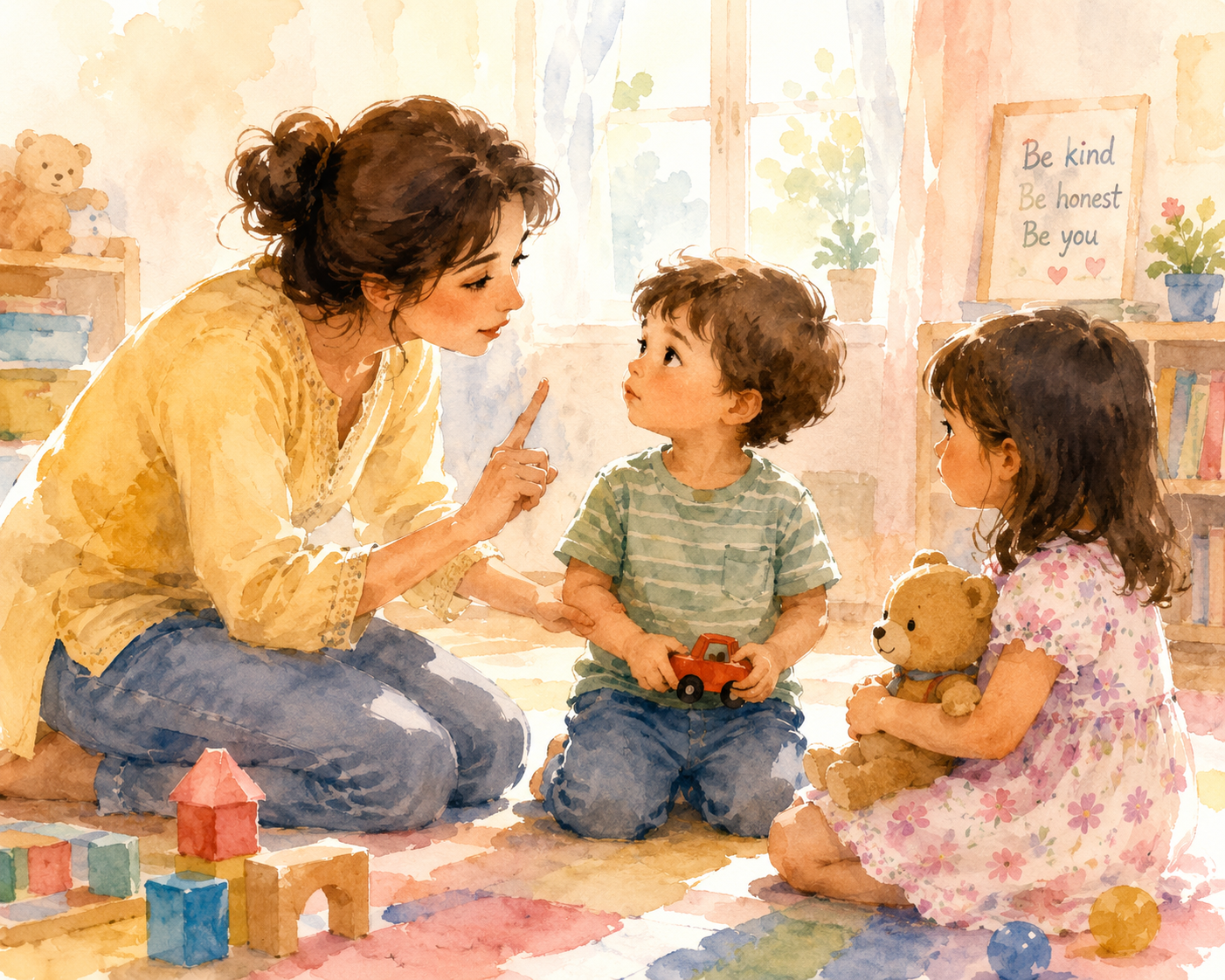
Our children will make countless mistakes of their own. They will snatch, hit, tease, break things and say hurtful words. These moments are not failures. They are opportunities to teach one of the most valuable life skills there is.
Here is how to guide a child from a quick "sorry" towards real repair.
Calm comes before conversation. A child in the grip of anger or embarrassment cannot think about someone else's feelings. Help them settle first.
Help them notice the hurt. "Look at your sister's face. How do you think she's feeling right now?" Empathy begins with noticing.
Invite them to make it right. Instead of demanding an apology, ask: "What could you do to help her feel better?" Children often come up with wonderful ideas: rebuilding a tower, fetching an ice pack, sharing a toy, drawing a picture, or giving a hug if the other child wants one.
Let the apology come when it's real. A sincere sorry, offered once a child understands the hurt, is worth far more than a forced one given in the heat of the moment. You can gently offer the words if they need help: "Would you like to tell him you're sorry?"
Teach the full shape of an apology. As children grow, you can teach them a simple four-part apology that works for a lifetime:
I'm sorry for… (what I did).
It was wrong because… (how it hurt you).
Next time, I will… (what I'll do differently).
How can I make it right?
Most of all, let them see you do it. Children learn repair not from lectures, but from watching the adults they love apologise honestly, and then change.
Here is a quick guide for those everyday moments:
|
Instead of… |
Try… |
|
"Say sorry right now!" |
"Let's calm down first. Then we'll work out how to make this right." |
|
"Just apologise so we can move on." |
"How do you think he felt when that happened?" |
|
"Sorry isn't good enough!" |
"What could you do to help her feel better?" |
|
"I'm sorry, but you made me so angry." |
"I'm sorry I shouted. That wasn't okay, and it wasn't your fault." |
|
"Sorry, okay? Let's forget it." |
"I've been thinking about what happened. Can we talk about it?" |
❦
When Parents Disagree: Let Children See the Repair
Many parents try hard never to argue in front of their children. It is a loving instinct. But research suggests something surprising: what matters most is not whether children see disagreements, but whether they see them resolved.
The psychologist E. Mark Cummings at the University of Notre Dame has spent decades studying how children respond to conflict between their parents. His work shows that hostile, frightening conflict harms children's sense of security. But constructive conflict, where parents disagree calmly, listen, compromise and make up, is linked with better outcomes for children over time. Cummings has observed that when children watch parents disagree and then resolve it, they are actually happier than they were before. Seeing the repair reassures them that the family is strong enough to work things through. Even a partial solution can do this.
So if your child witnessed an argument, let them witness the repair too. And if the repair happened privately, tell them about it: "You heard Mumma and me disagreeing earlier. We talked it through, and we're okay now. Grown-ups disagree sometimes, and then we make up." Those simple words can lift a heavy weight from a small heart.
❦
Repair Between Adults: Partners, Friends and Family
The same principles that heal a parent–child rupture hold true for every relationship. A few additional truths help with adult relationships.
Repair can happen in the middle of an argument, not just after. Gottman calls these small gestures repair attempts: a touch of humour, a softer tone, "Can we start over?", "I know I'm being defensive," or simply reaching for the other person's hand. These tiny moments stop an argument from spiralling, and his research found that how well couples repair is one of the main factors in whether a relationship flourishes.
Repair works best in relationships that are already warm. Gottman found that the success of a repair attempt depends less on the exact words than on the emotional climate between two people. When a relationship is filled with everyday kindness, appreciation and friendship, repair attempts are received gently. When it is filled with criticism and distance, even the best apology may bounce off. This means the best time to prepare for repair is on the peaceful days, through small, daily acts of warmth.
Repair is a dialogue, not a speech. Real repair means both people get to speak and both feel heard. Sometimes the person who was hurt needs to explain the impact more than once. Patience here is part of the repair.
Repair cannot be rushed. Sometimes a hurt person needs time before they are ready to reconnect. Offering repair, and then waiting respectfully, is itself a sign of care.
❦
When Sorry Isn't Enough: An Honest Word
Repair is powerful, but it has limits, and it is important to be honest about them.
When the same hurt happens again and again, and every time it is followed by an apology and a promise, the apologies begin to lose their meaning. Real repair always includes change. Without change, "sorry" becomes a pattern rather than a healing.
It is also important to say clearly that repair is meant for the ordinary ruptures of loving relationships: impatience, misunderstandings, harsh words. It is not a way to excuse or cover up abuse, violence or ongoing cruelty. If anyone in a family is being harmed, the priority is safety, and it is important to seek help from trusted people and professionals.
❦
It Is Never Too Late to Repair
Perhaps you are reading this and thinking of a rupture from long ago: years of harsh words with a child who is now grown, a friendship that ended in silence, a parent you never quite made peace with.
It is almost never too late to begin a repair. A sincere conversation, even decades later, can still mean a great deal: "I've been thinking about how I used to shout at you when you were small. I was wrong, and I'm so sorry. I wish I had done it differently." Such words cannot undo the past. But they can change the way the past is held, by both people.
And sometimes the person we most need to repair with is ourselves. Every parent loses their temper. Every partner says things they regret. Guilt can be useful when it moves us to repair. But shame, the feeling that "I am a bad person," only drags us down. Treat yourself with the same understanding you would offer a dear friend: I made a mistake. I will make it right. I am still learning.
❦
The Gold in the Cracks
In Japan, there is a centuries-old art called kintsugi. When a precious bowl breaks, it is not thrown away or hidden. Instead, the pieces are carefully joined together with lacquer mixed with gold. The bowl is not returned to how it was. It becomes something new, its cracks shining with gold, often more beautiful and more treasured than before.
This is what true repair does for our relationships. It does not pretend the break never happened. It honours it, takes responsibility for it, and joins the pieces together with care. And very often, the relationship becomes stronger, deeper and more trusting than it was before the break.
Let us return, one last time, to Rhea and her father.
Imagine that this time, he does not rush a sorry at breakfast. Instead, that evening, he sits on the edge of her bed. "Rhea, I've been thinking about last night. I shouted at you and slammed your book shut. That was wrong, and it wasn't your fault. You were trying so hard. I think it made you feel scared, and maybe a bit stupid, and you are not stupid at all. Next time I feel frustrated, I'm going to take a break before I speak. And tomorrow, shall we do maths together? Slowly, no hurry. Maybe with a biscuit."
She is quiet for a moment. Then she smiles, just a little.
The next evening, she brings him her maths book.
That is repair. Not a word, but a return. Not just an apology, but a promise, kept.
"Sorry opens the door. Repair is how we walk back in, together."